QA Testing Course with Manual Testing Selenium with AI amp API TestingThe QA Testing Course at JustAcademy is designed for students fresh graduates working professionals and career switchers who want to develop practical skills in software quality assurance and testing This course introduces learners to Manual Testing Selenium Automation Testing
QA Testing Course with Manual Testing, Selenium with AI & API Testing
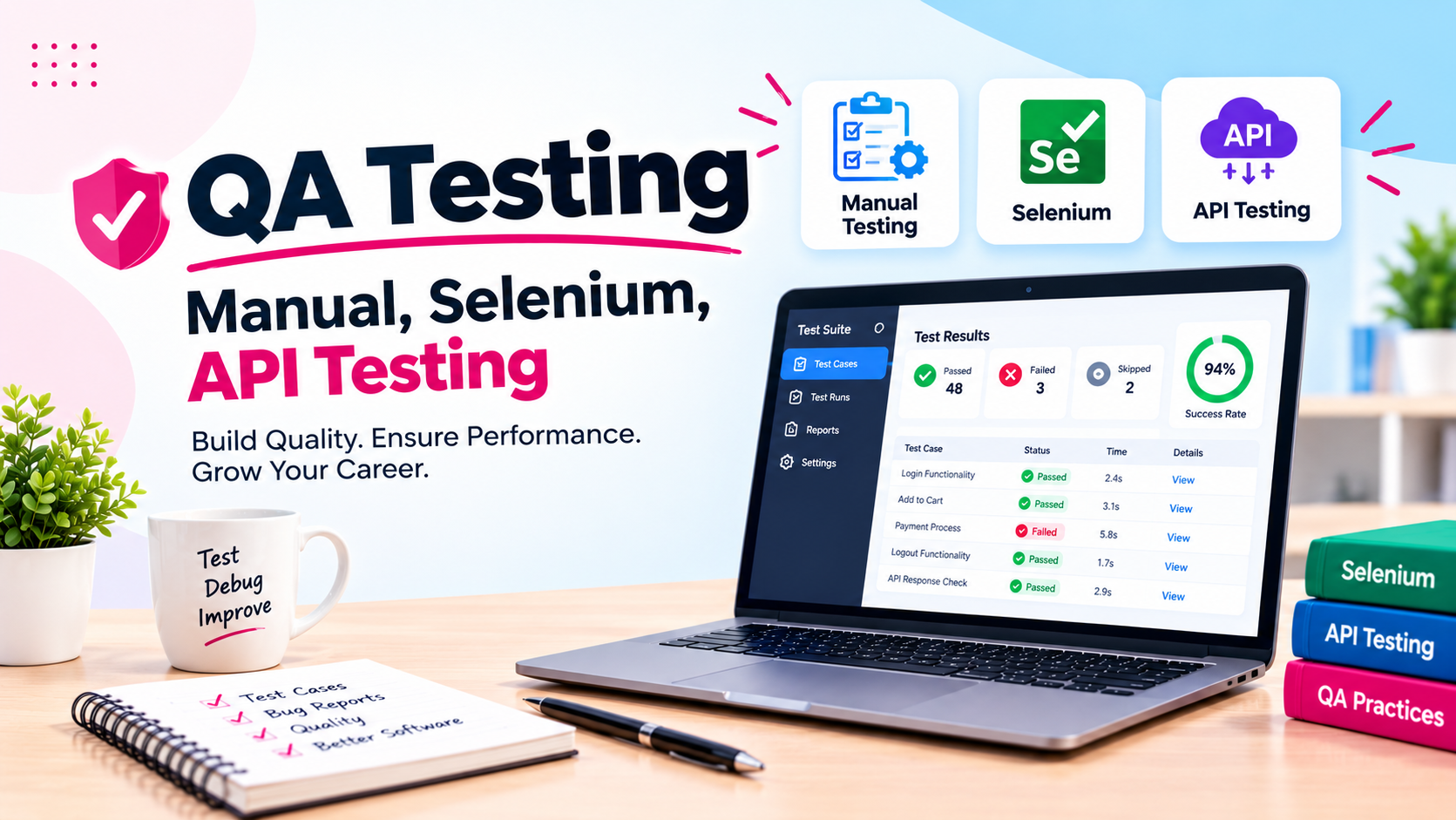
The QA Testing Course at JustAcademy is designed for students, fresh graduates, working professionals, and career switchers who want to develop practical skills in software quality assurance and testing. This course introduces learners to Manual Testing, Selenium Automation Testing with AI-assisted techniques, and API Testing, helping them understand how software applications are tested for functionality, reliability, and quality.
Software testing plays an important role in the software development lifecycle. Before an application is released, testing professionals evaluate its features, identify defects, validate user workflows, and verify that the application meets business and technical requirements. Quality Assurance (QA) professionals work closely with developers, business analysts, and project teams to improve software quality and reduce the risk of defects reaching end users.
Our Software Testing Course focuses on practical learning, testing concepts, automation tools, and project-based exercises. Learners can understand how to write test cases, report bugs, automate repetitive browser tests, and validate application programming interfaces (APIs).
The program covers Manual Testing, Selenium with AI-assisted testing techniques, and API Testing through a structured learning pathway. Live instructor-led sessions, practical exercises, and project guidance help learners connect theoretical concepts with real-world testing scenarios.
Whether you are looking for a QA Testing Course for beginners, a Manual Testing Course, a Selenium with AI Course, or an API Testing Course, JustAcademy provides a learning pathway focused on building relevant technical skills and preparing for software testing career opportunities.
What Is Quality Assurance and Software Testing?
Quality Assurance is the systematic approach to improving software quality by establishing processes, identifying risks, and verifying that applications meet expected requirements. Software testing is an essential part of this process and involves checking whether an application behaves as expected under different conditions.
For example, consider an e-commerce website where users can browse products, add items to their cart, make payments, and track orders. A QA tester checks these features to ensure that they work correctly, identifies errors, and verifies that the customer experience remains consistent.
Software testing may include manual testing, automation testing, API testing, regression testing, functional testing, and other testing approaches, depending on the application and project requirements.
A structured QA Automation Testing Course helps learners understand both the fundamentals of testing and how automation tools can make repetitive test execution more efficient.
Why Choose the QA Testing Course at JustAcademy?
1. Comprehensive Software Testing Skills
Learn the fundamentals of software quality assurance alongside practical testing techniques. The program combines Manual Testing, Selenium automation, and API Testing to introduce learners to different stages of the testing process.
2. Manual Testing Fundamentals
Understand how to analyze requirements, design test scenarios, prepare test cases, execute tests, identify defects, and document testing results. These foundational skills are important for beginners entering software testing.
3. Selenium with AI-Assisted Testing
Explore browser automation using Selenium and understand how AI tools can assist with test ideas, test case preparation, and documentation where included in the syllabus. Learn to review and validate AI-generated suggestions rather than relying on them without verification.
4. API Testing Skills
Learn how to validate application APIs, examine request and response data, check HTTP status codes, and verify whether backend services behave according to requirements.
5. Live Interactive Sessions
Participate in instructor-led sessions where you can follow demonstrations, ask questions, practise testing tasks, and clarify doubts with trainer guidance.
6. Practical Projects
Apply testing concepts to realistic application scenarios, including test case preparation, defect reporting, browser automation, and API validation.
7. Career Preparation and Placement Assistance
Develop practical project knowledge, improve your resume, and prepare to explain testing concepts during interviews. Placement assistance may include relevant job referrals and opportunity sharing, subject to eligibility and availability.
QA Testing Course Curriculum: Tools and Topics Covered
The curriculum is designed to help learners understand the testing workflow, from identifying requirements to executing tests and reporting defects.
Module
Topics Covered
Practical Application
Software Testing Fundamentals
SDLC, STLC, testing principles, testing types
Understanding the software testing lifecycle
Manual Testing
Test scenarios, test cases, functional and regression testing
Verifying application features
Defect Management
Bug reports, defect lifecycle, severity and priority
Documenting and tracking software defects
Test Design Techniques
Boundary value analysis and equivalence partitioning
Note: The exact programming language, automation framework, AI tools, API testing tools, and project deliverables should be confirmed against the syllabus for your selected batch.
Manual Testing Course: Learn the Fundamentals
Manual Testing is the process of evaluating an application by executing test cases and checking whether the actual results match the expected results. It helps testers identify functional issues, usability problems, and unexpected application behaviour.
The Manual Testing Course module introduces learners to the core concepts needed to understand software testing workflows.
Key topics include:
Introduction to software testing and quality assurance
Software Development Life Cycle (SDLC)
Software Testing Life Cycle (STLC)
Functional and non-functional testing
Smoke testing, sanity testing, and regression testing
Test scenarios and test case preparation
Test execution and result documentation
Defect reporting and defect lifecycle
Severity and priority of bugs
Boundary value analysis and equivalence partitioning
Practical example: Test a registration form by checking valid inputs, missing fields, incorrect email formats, password requirements, and error messages. Record the results and report any defects discovered.
Manual testing provides a foundation for understanding application behaviour before moving into automation and API validation.
Selenium with AI: Automation Testing Skills
Selenium is a widely used framework for automating interactions with web browsers. It allows testers to create scripts that perform actions such as opening websites, entering data, clicking buttons, and validating application responses.
The Selenium with AI component combines automation fundamentals with the potential use of AI-assisted techniques for test preparation and documentation.
Topics may include:
Selenium WebDriver fundamentals
Browser setup and automation
Locators such as ID, name, CSS selectors, and XPath
Finding and interacting with web elements
Handling buttons, forms, and dropdowns
Waits and synchronization
Assertions and validation
Automation test execution and reporting
AI-assisted test case ideas and documentation, where included
Reviewing and validating AI-generated test suggestions
Practical example: Automate a login workflow on a sample web application. Enter credentials, submit the form, and validate whether the expected page or error message appears.
A Selenium automation project helps learners understand how repetitive testing tasks can be automated. AI can assist with drafting test scenarios or documentation, but testers must verify the results for correctness and relevance.
API Testing Course: Validate Backend Services
API Testing involves checking whether different software components communicate correctly. APIs allow applications to exchange data, retrieve information, authenticate users, and process transactions without requiring every interaction to occur through a graphical interface.
The API Testing Course module introduces the fundamentals of request and response validation.
Key topics include:
Introduction to APIs and REST architecture
HTTP methods such as GET, POST, PUT, PATCH, and DELETE
HTTP status codes
Request headers and parameters
JSON request and response bodies
Response validation
Positive and negative test scenarios
Authentication concepts
API test documentation
Basic API test automation concepts, where included
Practical example: Test a sample product API by retrieving product details, checking the response status, verifying the returned JSON fields, and testing how the service responds to invalid inputs.
API testing helps QA professionals validate backend behaviour independently of the user interface and identify issues that may not be visible through manual browser testing alone.
Real-World Projects in the QA Testing Course
Project-based learning helps learners apply their knowledge to practical software testing scenarios. Projects can be selected according to the course syllabus and learner progress.
Project 1: E-Commerce Application Manual Testing
Test the major workflows of an online shopping application.
Activities include:
Prepare test scenarios for registration and login.
Test product search and filtering.
Validate shopping cart functionality.
Test checkout workflows using a suitable test environment.
Record defects and prepare test execution reports.
Tools: Test documentation tools and spreadsheets, with other tools where included.
Project 2: Selenium Web Automation
Automate selected workflows on a sample web application.
Activities include:
Identify repeatable test scenarios.
Locate page elements.
Automate user interactions.
Add assertions to validate expected behaviour.
Execute the test scripts and review the results.
Tools: Selenium WebDriver and the programming language and framework specified in the syllabus.
Project 3: API Testing and Validation
Validate API endpoints for a sample application.
Activities include:
Send requests using supported API testing tools.
Verify status codes and response bodies.
Check required fields and data formats.
Test valid and invalid inputs.
Document failures and prepare an API test report.
Tools: Postman or another API testing tool, depending on the syllabus.
These projects can help learners demonstrate their understanding of test design, defect reporting, browser automation, and API validation during interviews.
Online QA Testing Course with Live Sessions
The QA Testing Course Online option is suitable for learners who want to attend instructor-led classes without travelling to the classroom.
Live sessions allow learners to follow trainer demonstrations, ask questions, discuss testing scenarios, and practise concepts during scheduled classes.
Learning features may include:
Live online instructor-led sessions
Trainer screen-sharing demonstrations
Guided practical exercises
Doubt-solving and discussion
Project guidance
Session recordings for revision, where provided
Learners who prefer in-person instruction can enquire about available classroom batches at JustAcademy in Borivali East, Mumbai. Batch schedules, delivery options, and timings should be confirmed before enrolment.
The focus is on interactive learning and practical application rather than depending exclusively on pre-recorded material.
Who Should Join This Software Testing Course?
The Software Testing Course may be suitable for:
Students and fresh graduates exploring IT careers
Beginners interested in quality assurance
Working professionals seeking software testing skills
Manual testers looking to understand automation
Learners interested in Selenium and API Testing
Career switchers exploring software testing roles
Professionals who want to strengthen their testing fundamentals
A programming background can be helpful for automation testing, but beginners can start with manual testing concepts and progress towards automation according to their learning needs.
QA Testing Career Opportunities
After developing relevant skills and practical project experience, learners may explore roles such as:
Job Role
Typical Responsibilities
QA Tester
Execute test cases and report defects
Manual Tester
Validate application functionality manually
Software Tester
Test software against defined requirements
Junior QA Engineer
Support test execution and defect tracking
Automation Tester
Develop and execute automated test scripts
Selenium Automation Tester
Automate browser-based application workflows
API Testing Associate
Validate API requests and responses
QA Analyst
Review requirements, testing results, and quality risks
Job responsibilities vary by employer. Automation roles generally require additional programming and framework knowledge, while API testing roles require an understanding of requests, responses, and service behaviour.
Software Testing Salary in India
Software testing salaries depend on experience, location, technical skills, industry, employer, and interview performance. The following figures are illustrative estimates for career planning, not guaranteed salaries or verified current market averages.
Experience Level
Indicative Annual Salary
Fresher / Entry-Level Tester
₹3–5 LPA
1–3 Years of Experience
₹4–8 LPA
3–5 Years of Experience
₹7–14 LPA
Experienced Automation / Senior QA Professional
₹12–20+ LPA
These ranges can vary significantly. Candidates with practical automation, API testing, programming, and framework experience may qualify for different opportunities than candidates with manual testing knowledge alone.
Completing a QA Testing Course does not guarantee a particular salary or job offer. Employers assess the candidate's overall skills, qualifications, experience, projects, and interview performance.
Placement Assistance at JustAcademy
JustAcademy provides placement assistance to support eligible learners as they prepare for job opportunities after training.
The process may include the following steps:
Course completion: Complete the relevant modules and practical exercises.
Project preparation: Review and understand your testing projects, including test cases, automation scripts, or API reports.
Resume building: Present your technical skills, projects, qualifications, and experience clearly.
Job referrals and opportunity sharing: Eligible learners may receive relevant openings or referrals based on available opportunities.
Employer interviews: Apply for suitable roles and participate in employer selection processes.
Placement assistance does not guarantee a job, internship, interview, or specific salary. Outcomes depend on individual performance, eligibility, employer requirements, and available vacancies.
Related Courses at JustAcademy
Learners who want to strengthen their programming or automation skills can explore these related courses.
Selenium Training Course
Explore the Selenium Training Course at JustAcademy to learn more about browser automation and Selenium-related concepts. This is a relevant next step for learners interested in building deeper automation testing skills.
Python Training Course
Explore the Python Training Course if you want to develop programming skills that can support test scripting, automation, and data handling. Python may be useful for testing workflows where it is included in the chosen automation stack.
Core Java Training Course
Explore the Core Java Training Course to develop Java programming fundamentals. Java can support Selenium automation projects that use Java-based testing frameworks.
Review each course's syllabus, delivery format, duration, and fees to select the learning path that best matches your goals.
Start Your QA Testing Learning Journey with JustAcademy
The QA Testing Course at JustAcademy introduces learners to Manual Testing, Selenium with AI-assisted techniques, API Testing, and practical software quality assurance workflows.
Through live interactive sessions, guided exercises, and project-based learning, learners can work towards developing the technical and analytical skills needed to pursue QA and software testing opportunities.
If you are looking for a QA Testing Course with Projects, a Manual Testing Course, a Selenium with AI Course, or an API Testing Course with Placement Assistance, contact JustAcademy to confirm the current syllabus, available batches, course duration, fees, and learning options.
Build your understanding of software testing, practise with realistic scenarios, and prepare to demonstrate your skills to potential employers.
Curriculum
Curriculum will get updated soon.
Ready to Transform Your Career?
Get expert guidance on course selection, pricing, and flexible payment options. Our education counselors are ready to help you succeed.
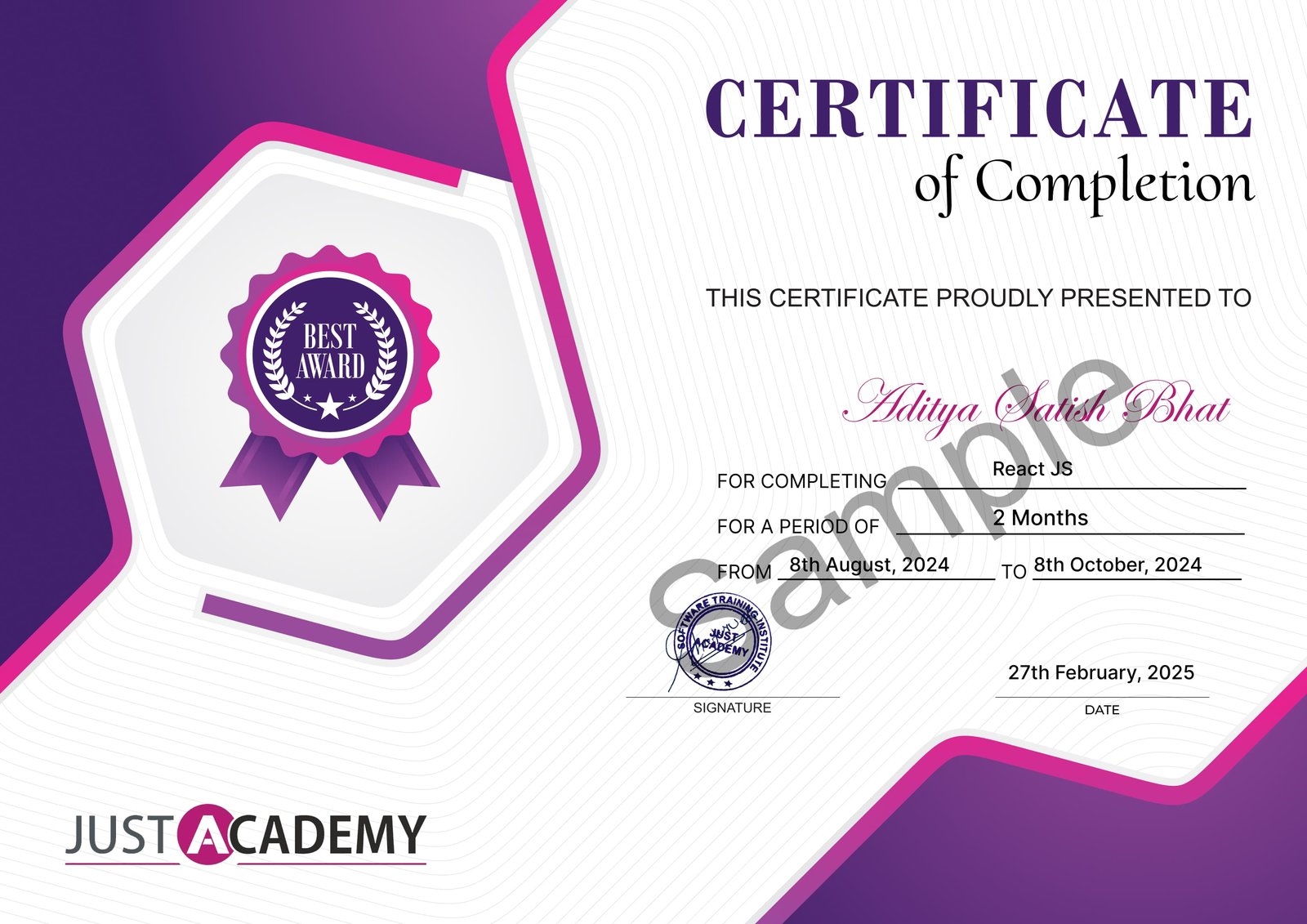
Upon successful completion of the QA Testing Course with Manual Testing, Selenium & API Testing course, you will receive a certificate from JustAcademy, validating your skills and expertise in this domain.
Industry-recognized certification
Validates your proficiency in QA Testing Course with Manual Testing, Selenium & API Testing
Enhances your resume and LinkedIn profile
Digital and printable formats available
Sample Certificate
What Makes JustAcademy Institute of Skills Training So Special?
The QA Testing Course at JustAcademy provides practical learning in Manual Testing, Selenium with AI, and API Testing. Learners develop software testing skills through live interactive sessions, hands-on exercises, real-world projects, and trainer guidance.
The course focuses on test case preparation, defect reporting, browser automation, API validation, and quality assurance fundamentals, along with resume building, interview preparation, and placement assistance to support career opportunities in software testing.